Three Legendary Crusader Leaders Who Fought for Christ and Changed History
Nearly everyone is familiar with the heroics, bravery and religiosity of the European crusaders. Most people know that the primary motivation behind the monumental efforts required to sustain, and support, the crusades was the need to recapture the Holy Lands, where Christ was born, preached and died, from the Muslims.
2025 "Christ Crusaders" Silver Proof Coin, by Chris Duane
But, unconscionably, many people are not familiar with the principal players in these astounding undertakings. And yet, their names should be as familiar to us as the current internet “influencers” because there has rarely been a more influential endeavor, shouldered by brave husbands, fathers and sons, than the crusades. And interestingly, despite the religious implications, they also changed the world through the trade routes they forged during their journeys. Chris’ new release, Christ Crusaders, enshrines three of those mighty men.
In order to fully appreciate these astounding logistical accomplishments, we need a better understanding of just how primitive life was during the time of the crusades. These monumental enterprises took place from 1096-1271, during what we now refer to as the “Dark Ages.” There were absolutely no modern conveniences. People grew their own food, built their own houses and rarely bathed. There were no schools, indoor plumbing and window glass was a novelty. Most people wove the fabric for their clothes at home, and rarely, in their short 35 year lifespan, did they travel more than a few miles from the place of their birth. And, worse yet, everything was covered in dirt, mud or human excrement which finally led to the Black Plague, which killed 50 million Europeans from 1347 and 1351. It was a pitiful existence.
The crusades promised adventure and travel that most people would never experience. But, despite the glorified writings about the crusades, they were extremely taxing, treacherous and deadly too, all of which required innate bravery to endure. Without Christ’s life of suffering, for the betterment of humanity, the crusades would have never been initiated. But, with Christ’s inspiration, seeking salvation became men’s life work and perpetuating the faith was their mission.
In reality, the great sense of adventure, camaraderie and purpose, which accompanied the start of most of the crusades, was quickly tempered by the reality of logistical nightmares, food shortages, blistering hot weather and disease, not to mention battling the Muslim enemy.
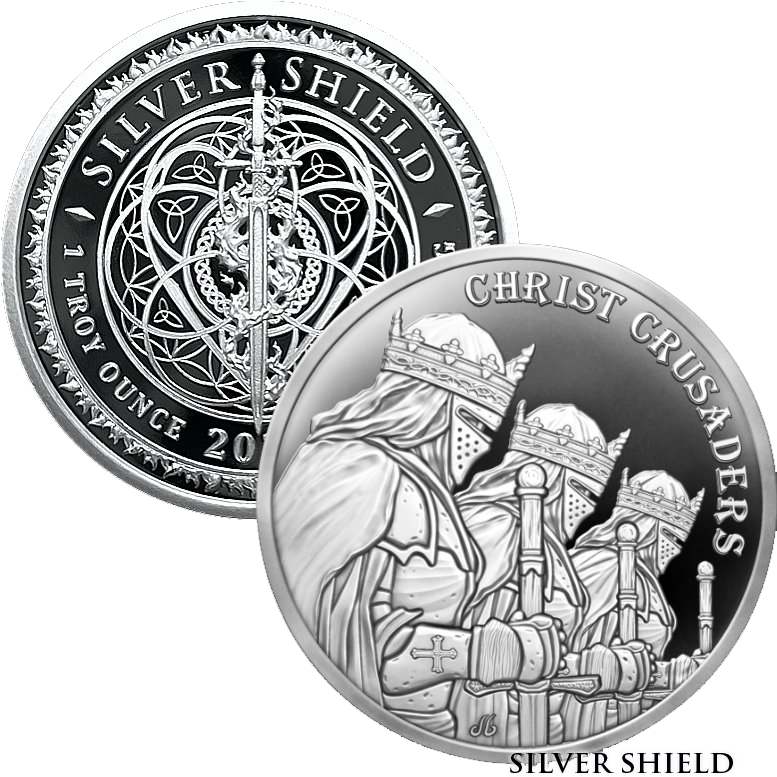
“Christ Crusaders” Silver Coin from Silver Shield
The initial crusades were arduous overland journeys. They were undertaken despite the fact that there were few roads that could sustain the passage of a 25,000 man army including horses, armament, carts and camp followers. As a result, the armies were propelled forward primarily by sheer manpower. The crusades were a constant test of men’s endurance, which many of the men swaggeringly welcomed. But, everyone still acknowledged that going on a crusade was definitely not for the timid or faint-of-heart, nor were they for cowards.
The First Crusade and Godfrey of Bouillon’s Bold Leadership
The First Crusade was initiated at Pope Urban II’s behest in 1096 and undertaken primarily by the French. The Pope’s goal was to recapture Jerusalem from the Muslims. Catholic crusaders from Europe assembled in Constantinople before proceeding to Jerusalem. The journey from Europe took three years and required traveling over 2,100 miles to reach their destination. 35 year old Godfrey of Bouillon, Duke of Lower Lorraine in France, is best remembered for his brilliant leadership during this initial crusade. He sold nearly all of his estates in order to raise an army. Through his bravery, inspiration and endurance the “First Crusade” was declared a success when Jerusalem was recaptured in 1099.
The Second Crusade: King Louis VII’s Struggle and Valor
The Second Crusade was initiated by Pope Eugene III in 1147. While the First Crusade was primarily undertaken by the men from France, the Second Crusade was composed of both French and German men. 26 year old Louis VII, King of France, and 53 year old Conrad III of Germany, who was the Holy Roman Emperor, led this expedition. The goals of this crusade were to recapture the first Crusader State, which was the County of Edessa. The crusaders were also instructed to reinforce the Kingdom of Jerusalem, which included the other Crusader states in the Holy Land. Although this Crusade was not as successful as the first, King Louis VII was its hero. He was a brilliant warrior and fought valiantly during the Battle of Mount Cadmus while “cutting off many heads and hands” of the attacking Turks.
The Third Crusade: Richard the Lionheart’s Heroic Campaign
Forty years later, in 1189, the Third Crusade was begun and once again combined the efforts of France and Germany. But this time, they were aided by England as well. This crusade was undertaken at the request of Pope Gregory VIII in 1187. The crisis to be addressed this time was the loss of the Crusader states, including Jerusalem, to Saladin, the Sultan of Egypt.
England’s King Richard the Lionheart arrived to save the day with 100 ships, 8000 reinforcements and much needed supplies. Today, King Richard is best remembered for his heroic clashes during the successful Battle of Acre. But, thanks to the many movies made about him, his bravery and leadership during the entire Third Crusade remains renowned.
When King Richard captured the important coastal city of Acre, he acquired, and then maintained, a stronghold along the entire 145 mile coastline from Tyre to Jaffa. As a result of Richard’s efforts, Saladin surrendered Acre. But, Saladin also agreed to allow Christians access to the holy sites within the region. The Kingdom of Jerusalem was secure, with Acre as its new capitol. Richard the Lionheart’s epic and heroic leadership in battle forestalled the complete collapse of the Christian presence in the region allowing the Kingdom of Jerusalem's continuation for another thousand years.
The Legacy of the Three Greatest Crusaders
Although there were a total of nine crusades to the Holy Land, England’s King Richard the Lionheart, France’s King Louis VII and Godfrey of Bouillon remain the three most heroically emblematic men from the era of the great crusades.
Chris’ new coin, Christ Crusaders, exemplifies these crusader’s determination, bravery and commitment to a cause they valued more than life itself.

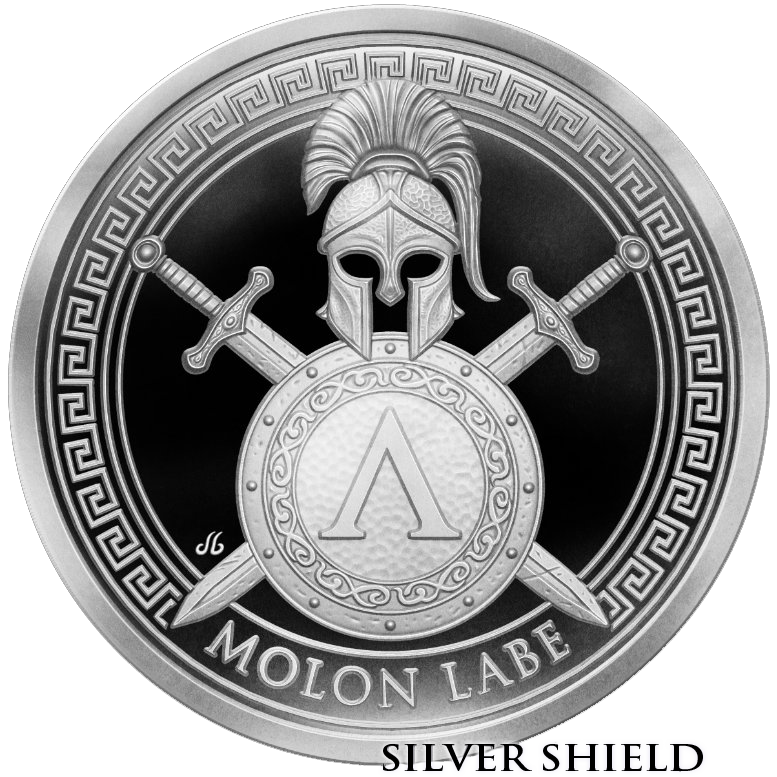

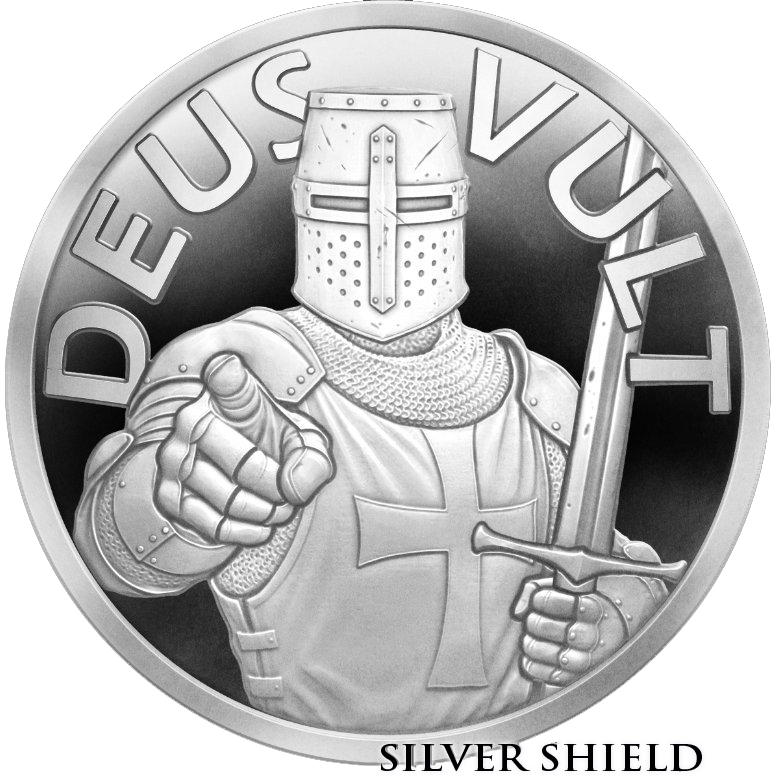
























































Other 2025 Silver Shield Proof Round releases