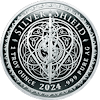
Chris’ new round, The Holy Trinity, is one of the most beautiful and inspiring strikes he has designed in recent years. Not only is it on par with some of the greatest Renaissance paintings of The Holy Trinity, in some cases, it actually surpasses them.
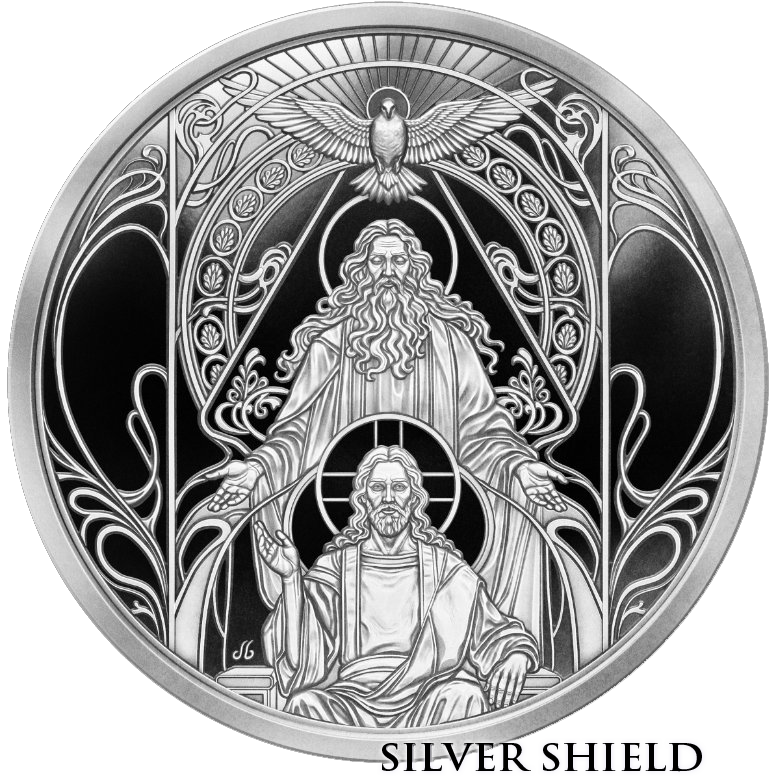
2026 “The Holy Trinity” Silver Proof Coin, by Chris Duane
Some of the most renowned European artists of the Renaissance period, including Botticelli, Hendrick van Balen the Elder, Masaccio and Albrecht Durer, created stunning depictions of the Holy Trinity. These paintings not only elicit powerful emotions but they emote visual majesty as well.
Balen’s painting, titled Trinity (1620), and Durer’s massive painting, Adoration of the Trinity (1511) are examples of the power and glory of the Holy Trinity, comprised of not only the Father, Son and Holy Spirit, but a host of angels and saints as well. Both paintings cannot be viewed quickly. Each requires extended periods of scrutiny to truly appreciate the drama contained within each depiction.
Botticelli's portrayal of the Trinity, titled, The Trinity with Saints Mary Magdalen and St. John (1492) and Masaccio’s painting titled, The Holy Trinity with Virgin and St. John and Donors (1427) are focused on the Holy Trinity itself, but with many fewer participants than were included in the two previous paintings.
Botticelli’s and Masaccio’s masterpieces are also more serene and contemplative in nature than the previous paintings. In addition, they have reduced the number of people included in their paintings. As a result, rather than including a crowd of people, the scenes only include the Blessed Mother, Mary Magdalen and St. John, all of whom were Jesus’ closest, and most beloved, relationships.
Chris’ coin, The Holy Trinity, surpasses all of the above mentioned paintings in one important aspect, he depicts the Trinity alone. The Father, Son and Holy Spirit are the only persons shown in the design. There aren’t any angels, saints, friends, donors or even the Virgin Mary, to draw the viewer’s focus away from the Trinity’s sacred subjects. It is purely, and solely, a depiction of the most important aspect of the Renaissance paintings, without all of the remaining distractions.
Catholicism was revealed to mankind as a monotheistic faith. That is to say, that although the Father, Son and Holy Spirit are three distinct persons, they are instead considered One God, not three. Each person is wholly One True God and only differs in their relationship to one another.
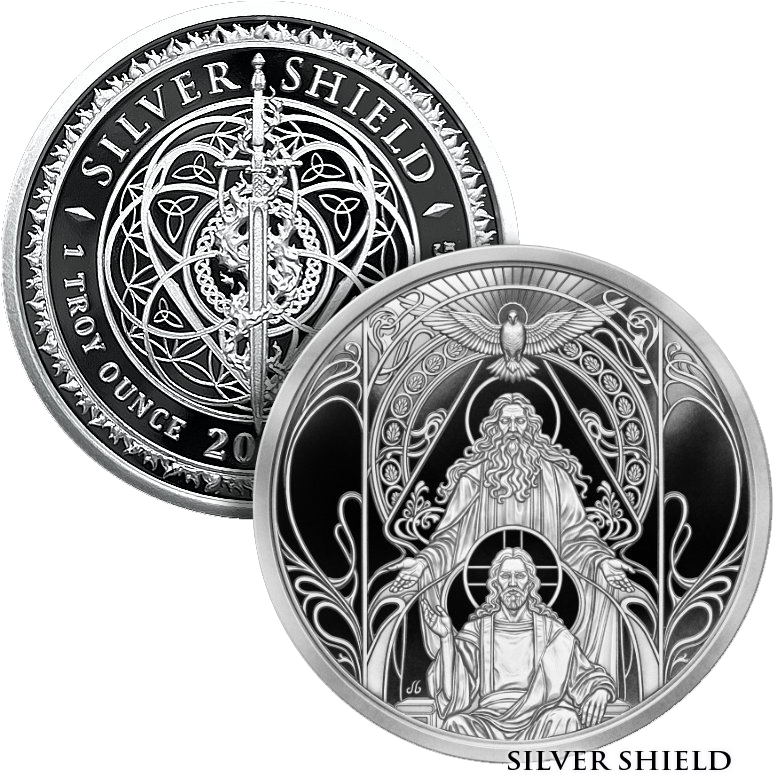
2026 “The Holy Trinity" Silver Proof Coin, by Chris Duane
Chris’ newly released round, The Holy Trinity, not only includes all three distinct, and co-equal, persons representing Catholicism's belief in One God but, unlike the Renaissance paintings, it shows the three persons as equal in their visual relationships to one another as well. As a result, the most obvious improvement is the increase in size of the dove that represents the Holy Spirit. He is shown in Chris’ round as truly equal in size, and Godliness, to the Father and the Son.
In all of the Renaissance paintings mentioned, the dove is drawn as it would be if it were encountered in reality. It is shown as a little bird, just as it would be if it were actually in the room with the people shown. This is not how Chris chose to represent the Holy Spirit on his round.
In Chris’ version, the Holy Spirit is of equal size when compared to the Father and Son. As a result, it is a superior depiction of the true relationship between all three persons of the Trinity. All three persons are not only illustrated as co-equal in their Godness, they are visually equal in size as well. This depiction represents The Trinity much more accurately.
Another intriguing, and captivating, aspect of Chris’ design, when compared to the ponderous paintings of the Renaissance, is his use of the fluidity, grace and embracing nature of the Art Nouveau style of design. The natural, flowing embodiment of this style of design literally encapsulates The Trinity and as a result, it effectively illustrates the beauty of One cohesive God.
Rather than highlighting the human reality, as portrayed in the Renaissance paintings, Chris has created a design that is superior to the master’s paintings by combining all of the crucial elements necessary to clearly, and concisely, demonstrate the Oneness of The Trinity alone.
The compelling nature of Chris’ newly released round, including his engaging artwork and impressive visualization, is truly captivating. But, more importantly, the focus of Chris’ new design is where it should be. It is exclusively on the Holy Trinity itself.
This is where Chris’ design has exceeded his predecessors. He has brilliantly illustrated The Holy Trinity in its purest, most elemental and unadulterated form, sans the noise, while at the same time, using the permanence of physical silver as his canvas.
As a result, this stunningly poignant, reverently beautiful and enduring silver round will forever remain a personal treasure and endure well into the future. And, unlike the Renaissance paintings, they will remain in your possession, thus avoiding the need to visit faraway European museums in order to enjoy them.












































Other Silver Shield Proof Round releases