If you mention the Rothschild name, the vast majority of people will know that they are bankers. But, most people do not know that they are one of the oldest banking families in the world. And although the Rothschilds can trace their family members back to Izaak Elchanan Rothschild, who lived in 1569, the firm was not established until the 1760s when Mayer Amschel Rothschild (1744-1812) founded of the banking dynasty in Frankfurt, Germany. The firm is still in existence today.
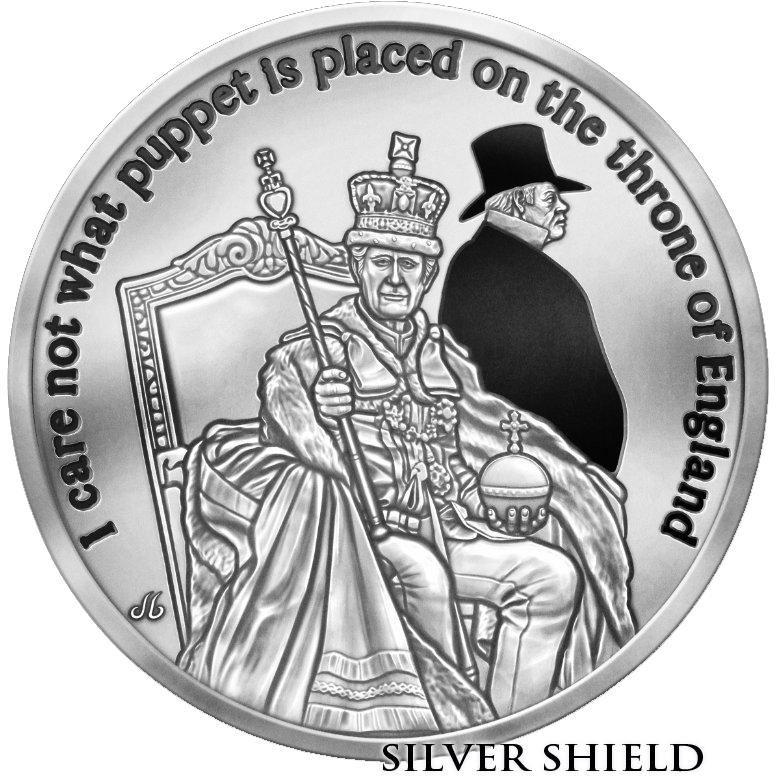
2026 "Puppet Throne V2" Silver Proof Coin, by Chris Duane
Mayer’s grandfather Amschel, with the help of relatives, became a dry goods trader in the Jewish Judengasse ghetto in Frankfort where he also had a currency exchange business and a rare coin business as well.
In 1757, Amschel became an apprentice to banker Jacob Wolf Oppenheimer at Simon Wolf Oppenheimer in Hanover. The training he received there would allow him to expand his business to include financial services.
Upon returning to Frankfort, he soon became the personal supplier of rare coins to the very wealthy Crown Prince Wilhelm I of Hesse, whose family dynasty could be traced back to 1264. The prince was an avid collector of rare coins and often resourced Amschel because he was a purveyor of low cost coins.
This was the beginning of the Rothschild’s association with monarchs and kings. The princes’ patronage led to Amschel being appointed Court Factor in 1769, in order to provide financial services to the crown. He was also permitted to use the Hesse coat of arms on his business documents, products and storefront. This told the world that his business held a “Royal Warrant of Appointment”, and as such, pronounced to his clientele that he was a reputable purveyor to the royal household.

2026 "Puppet Throne V2"Silver Proof Coin, by Chris Duane
Mayer Amschel Rothschild married Guttle Schnapper on August 29, 1770. They had five sons and five daughters, all of whom lived into adulthood. His business continued to expand through royal referrals given by the Prince of Hesse and who became King Wilhelm IX in 1785. He was also able to borrow capital from the King, and his kingdom, which allowed Mayer’s influence, and business, to expand exponentially.
Both the American Revolutionary War (1775-1783), and the French Revolution (1789-1799), propelled Mayer’s business even farther. During those two conflicts, Rothschild handled the payments made by the British, to the Hessian royal family, when they hired Hessian mercenaries to strengthen their own British Army.
Mayer Rothschild then undertook a European expansion of his bank which spread his influence well beyond Germany. Between the years 1804 to 1821 he sent his five sons across Europe to establish new branches of his bank in Vienna, London, Paris and Naples. The Rothschilds then became bankers to European governments, rather than simply to individuals. Britain became their largest client as they conquered, and colonized, their way around the globe.
As a result, the London office of the Rothschilds bank became the most powerful, influential and arrogant branch of their banking conglomerate. And, therefore, it does not seem unlikely that bank manager Nathan Mayer Rothschild (1777-1836) might have announced to his close business associates that, “I care not what puppet is placed upon the throne of England to rule the Empire on which the sun never sets. The man who controls Britain’s money supply controls the British Empire, and I control the British Empire’s money supply.” They were certainly powerful enough to throw their weight around with 1.8 million Euros in assets, which is 55 million Euros in today's market.
But, this is also where the waters get muddied. By the time the world went to war in the early 20th century, the Rothschilds had become bankers to the world. This included America, where the Rothschilds provided financial services through their agent, August Belmont & Co.
At that point in their history, every major country on the planet used Rothschild banks to finance their government bonds, infrastructure development and private industrial investments, such as railroads, shipping, mines and even the construction of the Suez Canal.
By the time World War I (1914-1918) devoured Europe, each branch of the bank was fully invested in its adopted countries' war effort. This placed them at odds, or even in contention, with each other as they raced to finance their countries involvement in the war. The Frankfort and Vienna branches supported the Central Powers of Germany/Austria-Hungary, while the Paris and London, and eventually the Naples, branches supported the Allied Forces.
As a result, they were financially supporting both sides of the conflict and getting very rich themselves because it didn’t matter who won the war, the Rothschilds always got paid and made huge profits. They understood that everyone was beholden to them because they controlled the cash flow to everyone involved in the war.
This situation alarmed many European officials and caused heightened tensions, and serious, unrelenting suspicion concerning the family's activities and loyalties. The bank never truly recovered the confidence, and trust, that governments had once placed in them after the conclusion of World War I.
Today Rothschild & Co., which is based in Paris, and Edmond de Rothschild, which is Swiss-based, do not even rank in the top 50 banks in terms of total assets. The Chinese and American Banks dominate those top spots, but their legacy remains intact. They were once the powerhouse of banking, and literally changed history and the world.
Whether these changes were for the better, or the for worse, is still being debated to this very day.




























































Other Silver Shield Proof Round releases