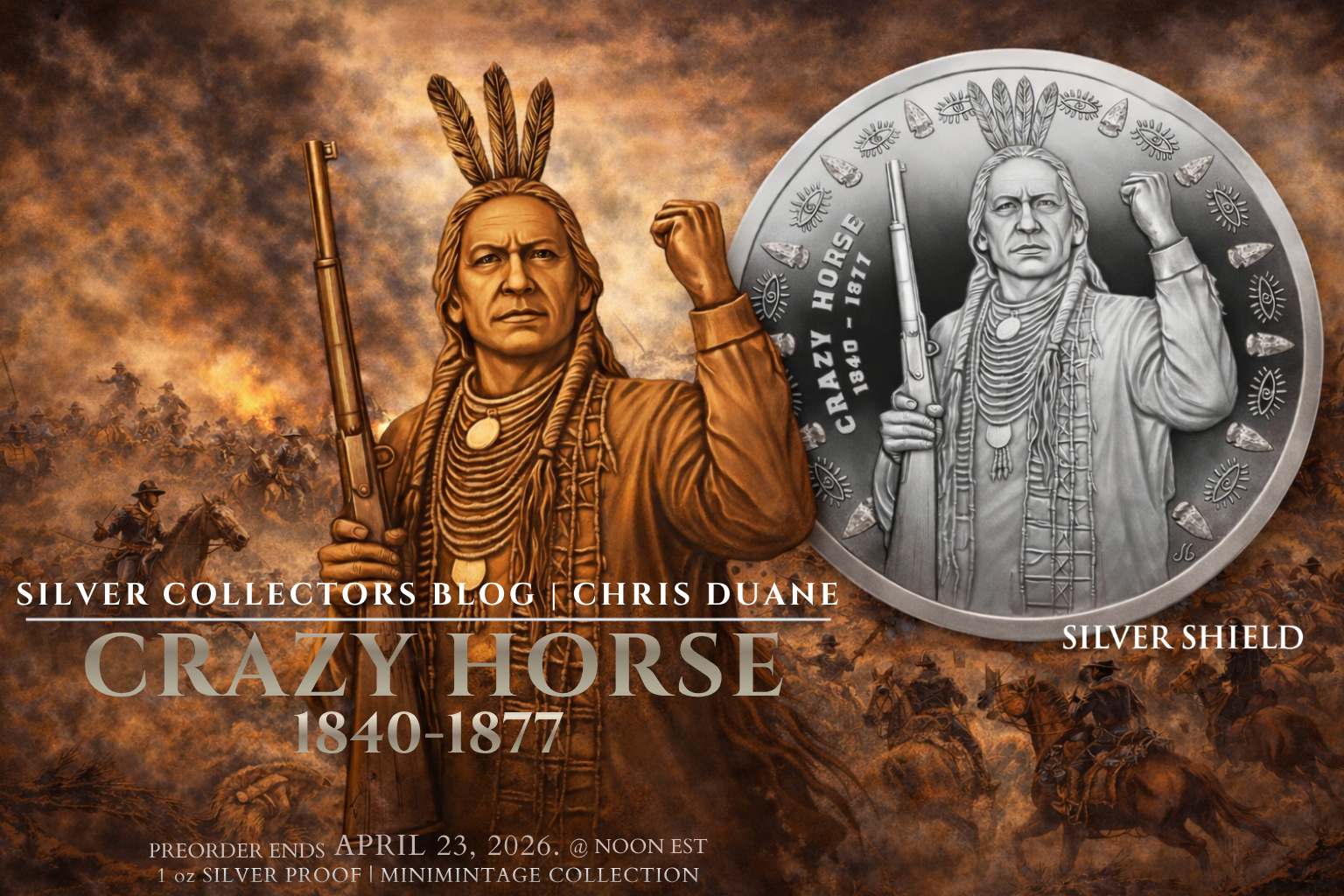
Chris’ new round, Crazy Horse, is a depiction of the Sioux Indian Chief who, along with the Lakota Chief Sitting Bull, were responsible for the massacre of Lt. Col. George Armstrong Custer’s 7th Cavalry battalion of 250 men, at the Battle of Little Bighorn, on June 25th,1876. Custer was attempting to return Sitting Bull to his reservation.
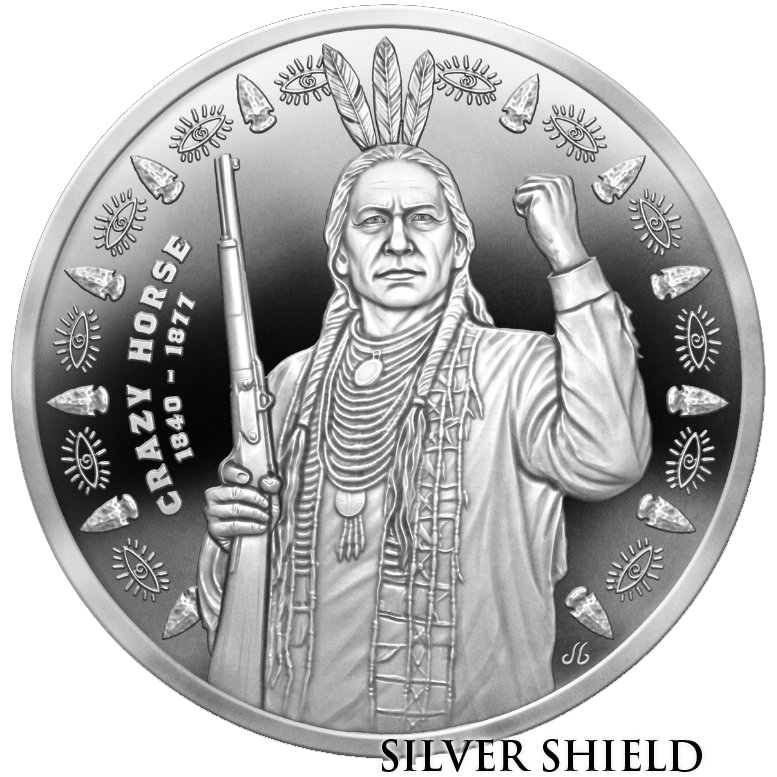
2026 "Crazy Horse" Silver Proof Coin, by Chris Duane
Crazy Horse’s simultaneous surprise attack on Brigadier General George Crook’s cavalry unit, during the Battle of the Rosebud Creek, delayed Crook’s troops from arriving in time to reinforce Custer’s men. By the time Crook arrived, Custer’s men had been scalped, stripped of their clothing, ritually mutilated and their bodies were partially decomposed. This made identification very difficult.
But, Lt. Col. Custer’s body was finally identified. He had two bullet wounds, one to the chest, which was believed to be fatal, and another in the temple, which was believed to have been delivered after his death. The rumor that Custer had committed suicide was disproved as he was right-handed and the wound was in his left temple.
Custer was initially buried with the remainder of his troops on the battlefield on June 2, 1876. But in 1877, his body was exhumed and reinterred, with full military honors, at the U. S. Military Academy Post Cemetery in West Point, New York.
“Custer’s Last Stand” is now memorialized as the Little Bighorn Battlefield National Monument, which is adjacent to the Little Bighorn River in Montana. This battle was the culmination of hundreds of brutal encounters with the Sioux Indians as European settlers pushed West, through Indian hunting grounds, in order to find gold or simply new farmland.
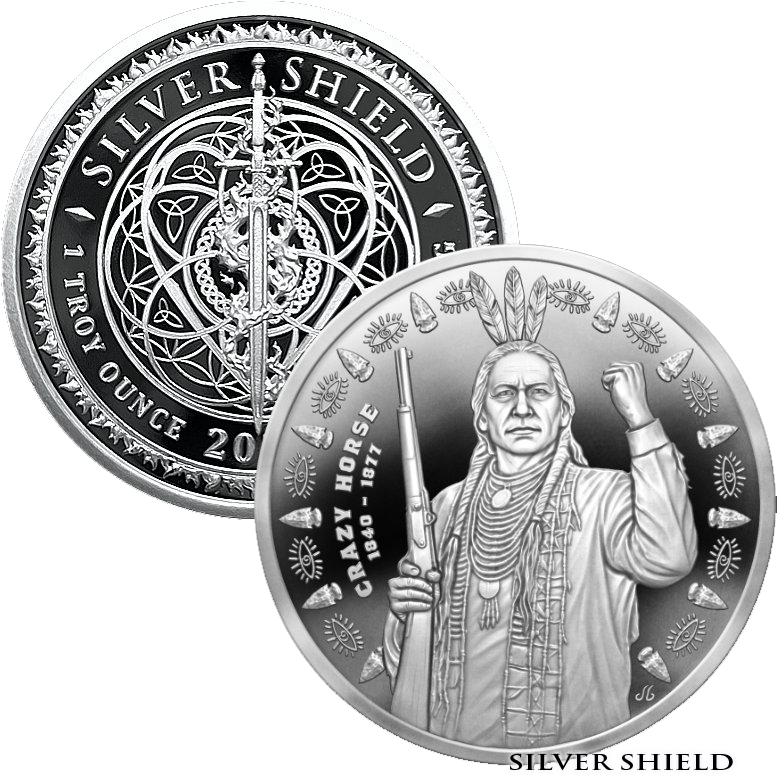
2026 "Crazy Horse” Silver Proof Coin, by Chris Duane
The Indians rejected this invasion, despite the settlers having no interest in the buffalo, and as a result, the Indians began to systematically slaughter innocent miners, farmers and settlers.
In 1862, the Sioux leader, Little Crow, massacred hundreds of men, women and children settlers in New Ulm, Minnesota alone. That same year, the Dakota Sioux uprising accounted for the deaths of 490 settlers. It is estimated that more than 19,000 white people were killed during Indian attacks.
The Sioux, including Crazy Horse, were constantly on the warpath from 1869-1876 throughout the Dakotas, Iowa and Minnesota. Although the Sioux were brutal warriors, the Comanche, Apache and Mohawk tribes were worse and these Indian tribes were also attacking white settlers at the same time.
The Sioux Indians were originally from the Mississippi River Valley. This warrior tribe was composed of people who spoke Lakota, Nakota and Dakota. They eventually moved West to find better hunting grounds and settled in modern-day North and South Dakota, Nebraska, Iowa, Montana, Wyoming and Minnesota. The Sioux were savage warriors and also attacked other Indian tribes, including the Crow, Pawnee, Mandan, Hidatsa and Arikara tribes, as they migrated North and West, devastating many of those tribes along the way..
Early on, the Sioux adopted the use of the horse during warfare. This gave them an unheard of advantage during battles with other tribes. As a result, their utilization of traditional weapons of Indian warfare, including clubs, axes and bows, became exponentially more lethal when wielded from the back of a galloping horse. This accelerated their conquest of local tribes, and soon after gave them control of the Missouri River Valley, as they moved North and West.
The Sioux attacks escalated when, in 1874, gold was discovered in the Black Hills of South Dakota. This caused a flood of miners to pour into the region. The Indian raids on innocent people, including men, women and children, intensified. Local militias were established in order to protect the white people from these attacks but the savage raids continued to increase. As a result, the U.S. Army was finally called in to stem the carnage.
These Indian attacks had a long-standing, and bloody, history in the New World. The first recorded battle with Indians took place in New England during the Pequot War of 1637-1638. The savagery of the Indian massacres of the white settlers was so extensive that the settlement of Plymouth was actually threatened. This war, referred to as King Philip’s War, continued for two years until the Indian leader, King Philip, was killed in 1676.
As more settlers arrived in America, the battles between competing Indian tribes were virtually dispensed with, as attacks on white people intensified. Many Indian attacks took place between 1689 and 1763. But this was the first time that Europeans accurately enlisted Indian tribes to fight with them against their own tribal enemies, as well as against their opposing European enemies. As France and England battled for control of Canada and the upper United States, the Indians took sides too and helped to attack each other's enemies as well.
This period included the French and Indian War, which was fought from 1754 to 1763. This war was part of the Seven Years War (1756-1763) and included a young George Washington, who was fighting with the British.
This war began with a dispute over the Ohio Territory but it resulted in the determination by the British to remove France altogether, from what was to become North America. The British won, with the help of the Iroquois Confederacy. At the Treaty of Paris in 1763, the British acquired vast tracts of land from the French, including all of Canada, the Ohio Territory and the Great Lakes Region.
This journey West continued when President Thomas Jefferson funded the Lewis and Clark Expedition in 1804. Merriweather Lewis and William Clark spent the next three years exploring the unknown territory west of the Mississippi River. They encountered many Indian tribes during their expedition, including the Teton Sioux, for whom Crazy Horse would become the Chief 60 years later.
The Sioux refused to allow the explorers passage over the Missouri River. The Indians demanded a toll of a boat and gifts. Lewis and Clark refused to comply and an armed standoff ensued. It was finally deescalated when the Sioux Chief relented and allowed their passage across the river. None of the explorers were killed during any of their hostile encounters with the Indians. But, they were both armed and willing to fight when confronted, and this alone helped quell the Indian’s desire to attack.
Next, the lengthy and violent Sioux Wars took place from 1854-1890. They started with small attacks on military outposts, but as more and more settlers moved West, the enraged Indians resorted to barbarism.
Despite the slaughter, Chris’ new strike shows Crazy Horse was a proud warrior. And he would prove to be one of the bravest Indian warriors of his time as he defended his tribe from the encroachment of the white settlers.
Crazy Horse was only subdued after many pitch battles, including the massacre of Capt. William Fetterman and his troop of 80 men in 1866, as well as the Wagon Box fight in 1867, which resulted in the death of Lt. Jenness and two of his men.
Chief Crazy Horse’s Sioux tribe was weakened, and starving, after a long cold winter. At this point, he finally surrendered to the same General George Crook, whom he had defeated at the Battle of the Rosebud Creek in Montana the previous year. His capitulation, along with 800 tribesmen, took place at the Red Cloud Agency in Nebraska on May 6, 1877. He was confined in nearby Fort Robinson and was killed in a scuffle with soldiers who were trying to imprison him in a guardhouse. He was 35 to 37 years old.
Today Crazy Horse is remembered as a ferocious warrior. He is immortalized, as he flies along on his racing stallion, at The Crazy Horse Memorial. This monument is a massive sculpture, which is being carved into the side of Thunderhead Mountain, in the Black Hills of South Dakota. It is truly impressive.
So, despite the terror Crazy Horse engendered while alive, as time has passed, his bravery and his commitment to saving his people, and his way of life from interlopers, cannot be denied. His short life has made a lasting impression on Americans who admire bravery and daring and he is remembered today as a part of our mutual American history.
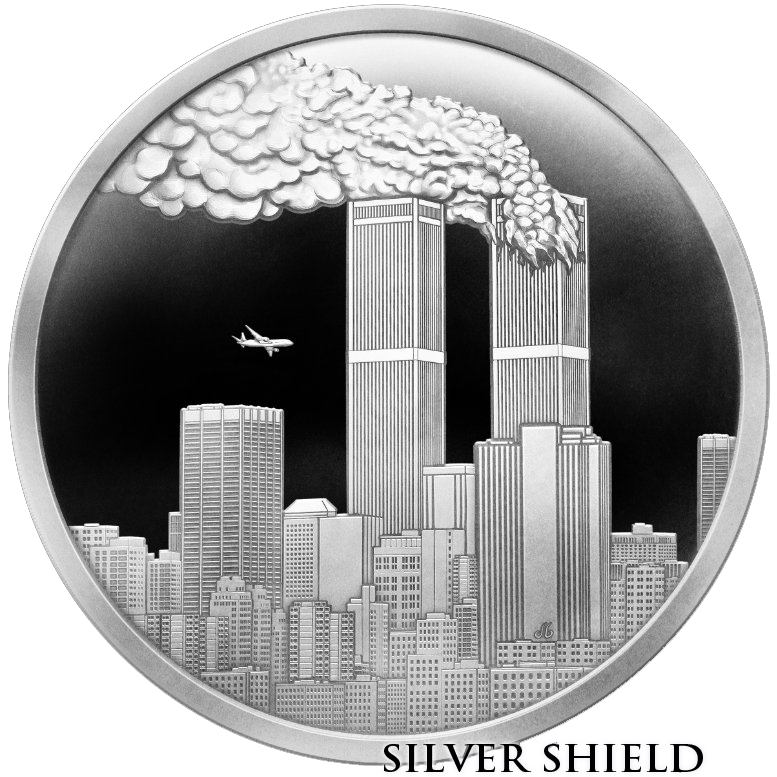




























Other Silver Shield Proof Round releases